Useful links from the article:
Let’s be honest: January in Scotland is usually about three things – dodging the horizontal rain, finishing off the last of the Haggis after Burns Night, and that looming UCAS deadline 2026 Scotland which feels like a giant shadow over your New Year. If you are currently sitting with three half-finished tabs open on the UCAS Hub, staring at a blinking cursor on your personal statement, you aren’t alone. Whether you are aiming for a big city university like Glasgow or Edinburgh, or a local campus closer to home, the pressure to get your Highers and your application “just right” is real.
At No Wrong Path, we believe that while deadlines are fixed, your future is flexible. There is no such thing as a “wrong” way to get where you want to be. This guide is here to help you navigate the SQA system, calculate your points accurately, and hit “submit” with total confidence before the January 29th cutoff.
Section 1: Understanding SQA Points
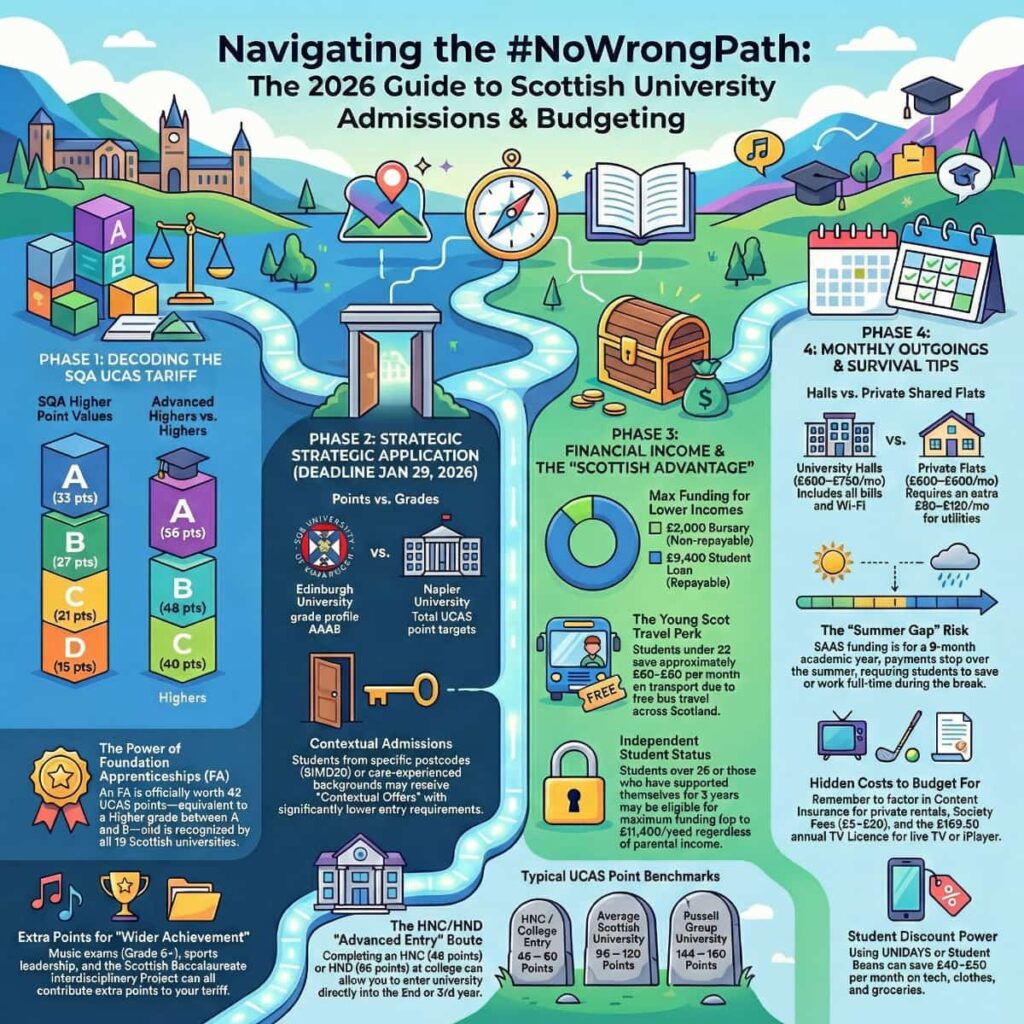
Before you get too deep into your application, you need to know exactly what your grades are worth in the eyes of admissions officers. Understanding the SQA Higher UCAS tariff is the first step in building a realistic and ambitious university list. To make your life significantly easier, you should use a UCAS points calculator SQA Highers to see where you stand right now.
Many students in Scotland underestimate their total, especially when they forget to include their National 5s or the extra value of an Advanced Higher. In the Scottish system, your points usually break down in a way that differs from the A-Level system down south. A “B” in a Higher isn’t just a letter; it’s a specific number of points that could be the difference between an unconditional offer and a rejection letter.
- Higher A: 33 UCAS points.
- Higher B: 27 UCAS points.
- Higher C: 21 UCAS points.
- Higher D: 15 UCAS points.
Using a UCAS points calculator SQA Highers helps you stay grounded. It’s easy to get caught up in the “prestige” of certain courses, but having a clear numerical view of your qualifications allows you to choose “Firm” and “Insurance” choices that actually make sense for your predicted grades. Remember, most Scottish universities are looking for a specific grade profile (like AAAB), but if you’re applying to universities in England, Wales, or Northern Ireland, that UCAS points calculator SQA Highers becomes your best friend for translating your Scottish success into the language they understand.
Section 2: Step-by-Step Application Guide
Navigating the how to apply to university Scotland process can feel like learning a second language. Between “Firm Choices,” “Insurance Choices,” and the technicalities of the UCAS Hub, it’s easy to get a bit muddled. The most important thing is to keep your information updated and accurate.
First, ensure your education history is complete. You must list every SQA qualification you have already achieved, including your Nat 5s. When it comes to your current Highers, you’ll list these as “pending” results. This is where your UCAS points calculator SQA Highers comes back into play-it helps you visualize what you are aiming for in May.
Your Personal Statement is your chance to shine beyond your grades. Don’t just list your subjects; talk about why you’re passionate about your chosen field. Whether it’s a part-time job in a local “chippy” that taught you resilience, or a hobby that’s developed your leadership skills, it all counts toward your “No Wrong Path” story. Scottish admissions tutors love to see “wider achievement,” so don’t be shy about mentioning your Duke of Edinburgh award or your volunteer work.
- Check the codes: Double-check your course and institution codes on the UCAS Hub.
- The Reference: Make sure your teacher or tutor has enough time to write your reference before the UCAS deadline 2026 Scotland.
- The Fee: Ensure you’ve paid the UCAS application fee, or your form won’t be sent to your chosen unis.
By consistently checking your potential totals with a UCAS points calculator SQA Highers, you can ensure that the universities you are applying to are a good match for your predicted grades. This saves you from the unnecessary stress of “over-reaching” or, conversely, selling yourself short.
Section 3: Foundation Apprenticeships & Advanced Highers
If you’re worried that your Highers alone might not be enough, or if you’re looking to stand out from the crowd, Scotland offers some fantastic alternatives. Many students don’t realize that Foundation Apprenticeship points are now widely accepted by almost every Scottish university as being equivalent to a Higher.
An FA is a brilliant way to get work-based learning while you’re still at school. It shows admissions teams that you have practical experience and the maturity to handle a professional environment. When you are looking at the UCAS tariff points for Highers, don’t forget that an FA can often bridge the gap if you’re slightly short of a specific entry requirement.
Advanced Highers are another great way to boost your score and prepare for the academic rigour of a degree. While they are a step up in terms of workload, they are fantastic preparation for the style of learning you’ll encounter in your first year.
- A at Advanced Higher: 56 points.
- B at Advanced Higher: 48 points.
- C at Advanced Higher: 40 points.
Using a UCAS points calculator SQA Highers allows you to see how adding an Advanced Higher or an FA can significantly change your total tariff. This gives you a much clearer picture of your options during the UCAS deadline 2026 Scotland rush. It’s about working smarter, not just harder. If you’re a “hands-on” learner, a Foundation Apprenticeship might actually be a better way to earn those vital points than sitting another traditional Higher. The SQA Higher UCAS tariff is flexible enough to reward different types of talent, so make sure you are taking advantage of every credit you’ve earned.
Section 4: Financial Prep
Once the stress of the application is over and you’ve checked your UCAS points calculator SQA Highers for the tenth time, the reality of “living costs” starts to sink in. Being a student in Scotland is great-hello, free tuition via SAAS! – but you still need to eat, pay for a roof over your head, and have a bit of a life outside the library.
The cost of living in 2026 has changed, and even with a SAAS award or a student loan, you need to be smart with your pennies. Before you decide which “Firm Choice” to accept, it is a very good idea to use a Scottish student budget planner to see what your monthly outgoings might look like in cities like Glasgow, Edinburgh, or Aberdeen.
Remember that while your UCAS points calculator SQA Highers gets you through the door, your budget is what keeps you there. Think about:
- Accommodation: Is a hall of residence or a private flat cheaper in your chosen city?
- Travel: Don’t forget your Young Scot card for free bus travel across Scotland!
- Food: Learn to cook a few basics now – your bank account will thank you later.
Having your finances in order early means you can focus on your exams in May without worrying about how you’ll afford your first week of Freshers. It’s all part of the “survival” strategy.
Final Countdown to January 29th
The UCAS deadline 2026 Scotland is the first major milestone of your adult life, but it doesn’t have to be a nightmare. By breaking the process down into manageable chunks – checking your points, refining your statement, and planning your budget – you’re already ahead of the game.
Keep using that UCAS points calculator SQA Highers to stay on track with your goals and adjust your expectations if needed. If your predicted grades aren’t quite where you want them to be, don’t panic. There are always pathways through college (HNC/HND), clearing, or even Graduate Apprenticeships.
You’ve got this. Take a deep breath, double-check your SQA candidate number, and get that application sent. The future is waiting, and in Scotland, there truly is no wrong path to success. Use every tool at your disposal, from the SQA Higher UCAS tariff tables to our budget planners, to make 2026 the year you start your next big adventure.
Frequently Asked Questions (FAQ):
How many UCAS points is an A* A* A*?
In the A-Level system, an A* is worth 56 points, making a total of 168 points. However, for Scottish students, it’s important to look at the SQA equivalent. Three Advanced Highers at grade A also carry 56 points each, totalling 168 points. If you are mixing Highers and Advanced Highers, the best way to see your total is to use our UCAS points calculator SQA Highers, which does the heavy lifting for you.
What is 64 UCAS points equivalent to?
64 points can be achieved through various combinations. In Scotland, this is roughly equivalent to two Highers at grade B (27 points each) plus some extra points from National 5s or a specific SQA award. Because there are so many ways to reach this number – including Foundation Apprenticeships – we recommend plugging your specific subjects into the UCAS points calculator SQA Highers to see your exact profile.
What’s 112 UCAS points in grades?
112 points is a common entry requirement for many UK universities. For a Scottish student, you could reach this with two Advanced Highers at grade B (48+48=96) and one Higher at grade D (15), or a mix of four Highers at grades AABB. Since every combination is different, check your specific grades against the UCAS tariff points for Highers to be sure.
Is it hard to get 120 UCAS points?
“Hard” is subjective, but 120 points is a very achievable goal for students taking a full spread of Highers and Advanced Highers. It typically requires a profile around BBB at Higher plus an additional qualification. If you’re feeling the pressure of the UCAS deadline 2026 Scotland, remember that points can also come from music exams, sports leadership awards, and Foundation Apprenticeships.
How to get UCAS points for international students?
International students don’t always use the UCAS Tariff system directly. UCAS has a dedicated team that evaluates international qualifications (like the IB or US High School Diploma) and translates them for UK universities. However, many Scottish universities will give you an offer based on your home country’s grades rather than a point total. If you have any UK-based SQA qualifications, you can still use our UCAS points calculator SQA Highers to see how they add up.
What is d* d* d* equivalent to in UCAS points?
The “D*” refers to Distinction* in BTEC qualifications, which are common in England but also taken by some students in Scotland. A DDD* (Triple Distinction Star) is equivalent to 168 UCAS points, the same as three A*s at A-Level or three As at Advanced Higher. It is a top-tier result that opens doors to most elite universities.
Does UCAS accept international students?
Absolutely. UCAS is the central hub for almost all undergraduate applications in the UK, regardless of where you are from. International students must follow the same UCAS deadline 2026 Scotland (January 29th) for most courses to ensure they are given “equal consideration.”
Can I go to university with 112 UCAS points?
Yes, many modern and regional universities across the UK have offers starting around 96–112 points. While “Ancient Universities” in Scotland might ask for higher grade profiles, 112 points is a solid score that provides plenty of options. Just make sure to use a Scottish student budget planner once you get your offer to see which city fits your lifestyle.
What grade gives 72 UCAS points?
72 points can be achieved with three Highers at grade C (21+21+21=63) plus 9 points from other smaller qualifications, or simply two Highers at grade A (33+33=66) and one National 5 at grade D. To find the exact combination that fits your transcript, check our UCAS points calculator SQA Highers.
Are Foundation Apprenticeships worth UCAS points?
Yes! In Scotland, a Foundation Apprenticeship (FA) is typically treated as equivalent to one Higher. Most Scottish universities recognize the FA as a “B” at Higher (27 points) or even an “A” (33 points) depending on the institution. This is a game-changer for students who prefer practical learning over exams.
What happens if I miss the UCAS deadline 2026 Scotland?
If you miss the January 29th deadline, you can still apply through “Late Application,” but universities are not required to consider you if the course is already full. Your next best chance would be UCAS Clearing in the summer. To avoid this, keep an eye on the clock and get your UCAS tariff points for Highers calculated early.
Can I use National 5 grades for UCAS points?
While some universities focus primarily on Highers and Advanced Highers, National 5s do technically carry UCAS points (e.g., an A at Nat 5 is 8 points). However, most competitive courses use Nat 5s as “entry requirements” (like needing a B in Maths) rather than adding them to your total tariff. Use our calculator to see if your specific uni choices count them!